

Every year, around the time we start thinking of decor, festivities, invites and I notice that Diwali has become two festivals. One is the festival. The other is built for social media: flawless rangoli dusted with glitter, matching outfits, Diwali favors in cellophane, a table of single use everything that goes to the curb the next morning.
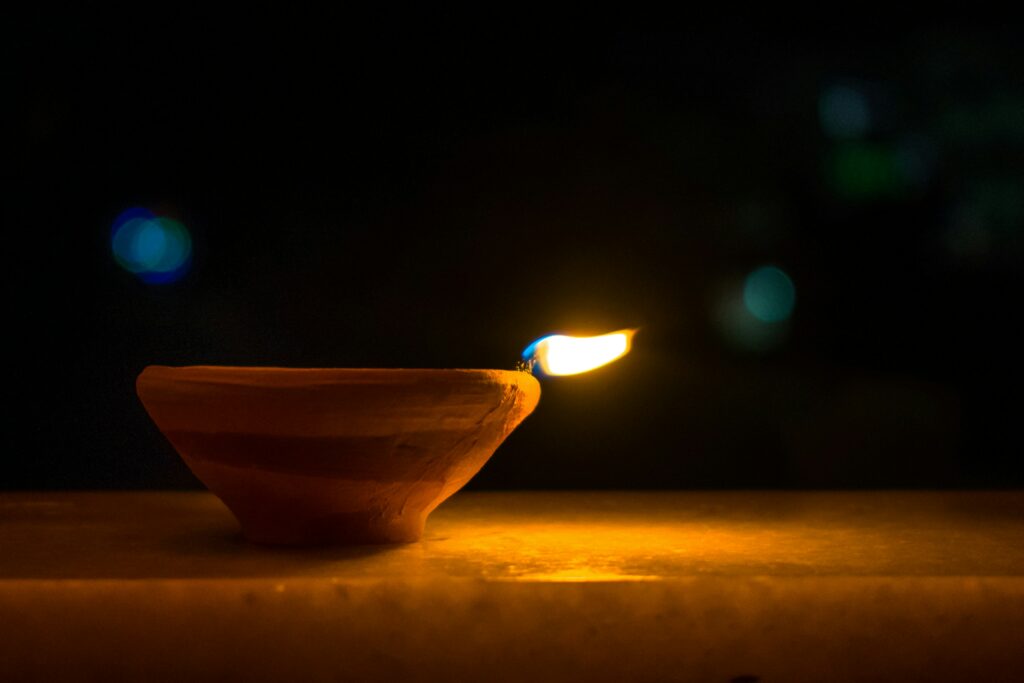
I understand the pull. We want our homes to look beautiful, and we want to honor something we love. But the original story of this festival was rather humble. A clay lamp, a cotton wick, a little oil, and earth. Nothing in that list needed to be improved.
What the lights were for
Dīpāvalī (दीपावली) means a row of lights, from dīpa, lamp, and āvali, row. Diwali is observed across Hindu, Jain, and Sikh traditions, and each tells its own story. Many Hindus remember Rāma’s return to Ayodhya, or worship Lakṣmī, or recall the victory over Narakāsura. Jains mark the nirvāṇa, the final liberation, of Mahāvīra. Sikhs observe Bandi Chhor Divas, the day of release.
The stories differ, but the thread running through them is the same: light over darkness, knowledge over ignorance. The lamp was never just a decoration. It was a clear reminder to turn toward clarity.
That is the question I want to carry through this season. For every choice, I ask: does this deepen the festival, or does it only decorate it? Think presence over performance.
Taking what you need
The yogic word I keep returning to is aparigraha, non hoarding. It means taking what you need and holding the rest lightly. Maharishi Patanjali lists it among the yamas, the ethical foundations of the path, and in Yoga Sutra 2.39 he connects it with a widening of perspective, a clearer view of the longer arc of a life.
अपरिग्रहस्थैर्ये जन्मकथन्तासम्बोधः
Aparigraha-sthairye janma-kathantā-sambodhaḥ
A common rendering: When one is steady in non-grasping, knowledge of the how and why of births arises.
I find that practical, not abstract. Grasping narrows the view. When we are busy acquiring for the festival, we stop seeing the festival. So buy less. Buy once. Before you buy anything, ask where it will go when the festival ends. A plastic garland lasts one evening in your home and then far longer than any of us in the earth.
Use what you have, then choose better
Start by reusing. The diyas from last year, the toran on the door, the brass lamps, the decor in the box in the hall closet. Most of it is still perfectly good.
Then, when you do need something, choose what returns to the earth easily. Clay diyas, cotton wicks, plant based oil or ghee. Compostable plates for the crowd. Marigolds, mango leaves, banana leaf, flower petals. Rangoli made with rice flour instead of synthetic color and glitter. The earth is already beautiful. It does not need our help looking that way.
Clean to make room, not to impress
Clearing the home before Diwali is an old and meaningful practice, and it belongs to śauca (शौच), cleanliness or purity, one of the niyamas. The point of it was always to make room, for light, for abundance, for the guest who arrives. It was never to impress anyone.
So clean with that intention. And let what you no longer use move on to someone who will use it, instead of into the bin. A spotless house that produces a mountain of trash is not fully clean. Śauca asks us to look at the whole picture, including where the dust goes.
Make something with your hands
If you have the time and space, make something. Paint a diya. Draw a rangoli with crooked lines. Cook a sweet that doesn’t look like the one in the shop, or write a card by hand.
The satisfaction is a different kind. It does not need to look curated or perfect, and I mean that. If this season is already full, skip this one with no guilt. This is an invitation, not an assignment. There is nothing to prove and lead with that clarity.
What performance takes from us
There is a quieter yogic idea underneath all of this: asteya (अस्तेय), non stealing. We usually think of it as not taking what is not ours. But performance and pretending steals too.
It steals attention from the moment, because we are composing the picture instead of standing in the light. It steals ease from our guests, who feel they must match what we’ve staged. And it steals from the earth and from people who have no say in what we throw away.
So it is okay to say no. To the extra event, the extra gift, the extra outfit. And by the same measure, say yes to what actually feeds you. A quiet evening with the people you love may be the most generous thing you can host.
Light one lamp from another
One of the oldest images of this festival is also the simplest. You can light one lamp from another and the first does not grow dim. Light does not work like a limited resource.
That is dāna, giving freely. Give to someone who has less. Donate to a shelter. Instead of sending guests home with party favors, host a donation drive and let people bring something to give. Pass along the things you cleared out in the weeks before. Let the light travel.
A wish for you
Śubh Dīpāvalī. May your home be lit by presence, not performance. May the lamp on your threshold be small and steady and plenty.
