
By Arundhati Baitmangalkar | Aham Yoga
There’s a sound in most yoga studios across America that has become so familiar it barely registers anymore. A low, oceanic hiss. A controlled, slightly theatrical breath that fills the room from the moment class begins to the moment it ends. My friend and fellow yoga educator Andrew McGonigle calls it the Darth Vader breath and honestly, he’s not wrong.
That sound is Ujjayi. And I have a complicated relationship with it.
Not because Ujjayi isn’t a valuable practice — it absolutely is. But because somewhere along the way, this one breathing technique became synonymous with yoga breathing itself. As if Ujjayi is what your breath is supposed to sound like. As if breathing in yoga means breathing with a partially constricted glottis, always, in every pose, from the first sun salutation to the final savasana.
I want to talk about what’s been lost in that assumption. And I want to talk about what breathing in yoga can actually become when you’re willing to look beyond the one technique everyone knows.
What I Noticed Studying Yoga in India
I was trained in India. Also born & raised there. I’ve studied with teachers whose teachers studied with teachers who learned this practice as a living tradition, not a fitness methodology. And one of the things that struck me most now living in the United States was how absent Ujjayi was in the Indian yoga classroom.
Not because Indian teachers don’t know it. They know it deeply. But because they understand it as one tool among many – a specific technique for specific purposes and not the ambient soundtrack of every yoga class.
In India, I watched teachers guide students through vigorous sequences without a single instruction about the breath sound. The breath was present, it was intelligent, it was working — but it wasn’t Ujjayi. It was something older and more fundamental: the natural intelligence of the breath itself, moving in response to the body’s needs.
Coming back to the West, the contrast was startling. “Ujjayi breath” had become a cue delivered in the first five minutes of almost every class, applied universally, maintained continuously, regardless of the pose, the student’s capacity, or the energetic intention of the practice.
I started asking myself: how did this happen? And more importantly, what are we missing?
What Ujjayi Actually Is — And Where It Comes From
Let’s start with the basics, because the yoga history matters.
Ujjayi comes from the Sanskrit roots ud — meaning upward or superior — and ji — meaning to conquer or be victorious. Ujjayi, then, is the victorious breath. The breath that rises upward. The name alone tells you something about its nature — this is not a passive, ambient breath. It’s a breath with intention and direction.
The technique itself involves a slight constriction at the glottis — the back of the throat during both inhalation and exhalation. This constriction creates the characteristic ocean-like sound and produces several distinct physiological effects. The breath slows. Intra-abdominal pressure increases. The nervous system begins to regulate. The mind, given something to anchor to, grows quieter.
Classically, Ujjayi appears in the Hatha Yoga Pradipika — one of the foundational texts of Hatha yoga — where it is described as a pranayama practice to be done seated, with specific ratios of inhalation, retention, and exhalation. It appears again in the Gheranda Samhita, another classical Hatha text, where its benefits are enumerated clearly: it destroys phlegm at the throat, eliminates disorders of the nadis, and increases the digestive fire.
What neither of these texts describes is Ujjayi as a breath to be maintained throughout an entire dynamic asana practice. That is a modern innovation and not necessarily a bad one, but one worth understanding clearly.
The Physiology : What Ujjayi Does to Your Body and Mind
To be clear: Ujjayi does remarkable things. Understanding what it actually does helps us use it with genuine intelligence rather than habit.
In the physical body:
The glottal constriction slows the breath down significantly. A slower breath means more time for gas exchange in the lungs — more oxygen absorbed, more carbon dioxide released. This is why Ujjayi practitioners often feel calmer and more oxygenated after practice.
The constriction also creates what physiologists call increased intra-abdominal pressure — a gentle internal bracing that supports the spine during dynamic movement. This is particularly valuable in standing poses, transitions, and vinyasa sequences where the spine needs stabilization from within. Think of it as a natural corset, activated by breath rather than muscular grip.
Ujjayi also stimulates the vagus nerve – the primary nerve of the parasympathetic nervous system through the gentle pressure at the throat. This is why Ujjayi feels calming even in a physically demanding practice. You’re literally activating your rest-and-digest system while your body works.
In the mind:
The sound of Ujjayi creates what I sometimes call an internal white noise machine. When the mind has an auditory anchor – a sound it generates itself, it has less room to wander. Distractions quiet. The chatter softens. The breath becomes a moving meditation.
This is not metaphor. The relationship between breath and mind is one of the oldest and most reliable findings in the entire yoga tradition. As the Hatha Yoga Pradipika states: when the breath moves, the mind moves. When the breath is still, the mind is still. Ujjayi works with this principle directly.
The Gap Nobody Is Talking About
Here is where I want to be honest with you as a teacher, as a student, and as someone who has spent years thinking carefully about how we educate the next generation of yoga teachers.
In most modern yoga teacher trainings, students learn Ujjayi. They learn to cue it. They learn to maintain it. And then there is almost nothing else taught about the breath.
There is an entire spectrum of breathing —from simple belly breathing to the most refined pranayama practices in the classical tradition — that sits between “natural breath” and “Ujjayi,” and most modern yoga teachers have never been introduced to it.
Students learn to breathe in and breathe out. They learn Ujjayi. And that’s it.
But between those two points lies an entire world. The 4 parts of a single breath. The difference between belly breathing, diaphragmatic breathing, and full yogic breathing. The six qualities of breath and how to read them. The intelligence of when to inhale and when to exhale in a moving practice — and why getting this wrong is one of the most common and consequential teaching errors in modern yoga.
I call this body of knowledge Breath Literacy. And I believe it is the most underteached area in contemporary yoga education.\
Your Breath Is Not a Technique
This is the most important thing I want to say in this entire piece.
Ujjayi is a technique. Your breath is not.
Your breath is a living, intelligent force. It has been moving in your body since the moment you were born, long before you ever learned what Ujjayi was. It responds to your emotional state, your physical exertion, your nervous system, the season, the time of day. It communicates. It adjusts. It knows things your conscious mind doesn’t.
In the yoga tradition, this intelligence has a name: prana. And prana is not simply “energy” in the vague wellness sense of the word. The Sanskrit dictionary lists fourteen distinct meanings for the word prana – from life force to cosmic energy to the breath of consciousness itself. Prana is the animating intelligence behind all living things.
The breath is prana’s most tangible, most accessible expression. Every time you breathe, you are touching the edge of something vast.
And here is what the classical texts say, plainly and repeatedly: how your prana moves is how your mind moves. Control the breath, and you influence the mind. Allow the breath to become mechanical, habitual, or forced and the mind follows suit.
When we reduce “yoga breathing” to one technique applied universally, we are not deepening our students’ relationship with their breath. We are giving them a tool and calling it the whole toolbox.
What Makes Ujjayi Genuinely Unique
Having said all of that let me tell you what makes Ujjayi remarkable in a way that no other pranayama shares.
Ujjayi is the only classical pranayama that can be practiced in motion.
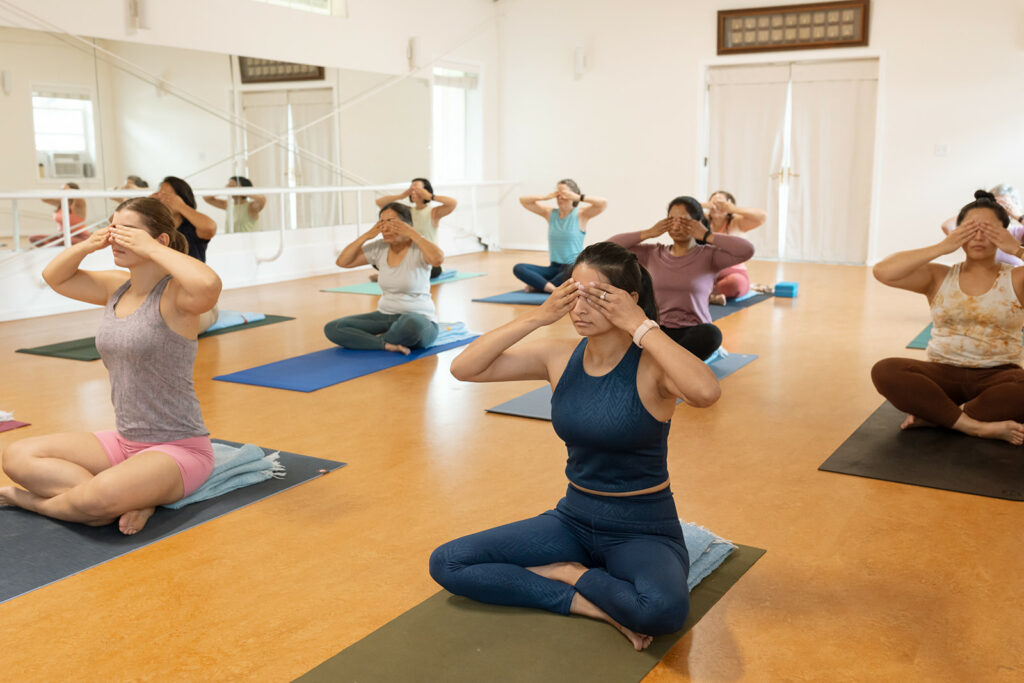
Every other pranayama in the tradition – Nadi Shodhana, Kapalabhati, Bhastrika, Brahmari, Sheetali — requires a seated, still, internalized state. Eyes closed. Body quiet. Full attention turned inward. These are not practices you can do while moving through a sun salutation.
Ujjayi can. And that is genuinely significant.
Because it can be maintained in dynamic movement, Ujjayi becomes a bridge between the physical practice of asana and the deeper world of pranayama. It introduces the practitioner to breath awareness, breath control, and the breath-mind relationship while they are moving, sweating, and learning to navigate a physically demanding practice.
This is its gift. Used with this understanding, Ujjayi is a remarkable teaching tool.
Where Ujjayi serves you best:
In rhythmic, repetitive movement like sun salutations, vinyasa flows, warm-up sequences – Ujjayi creates continuity. The breath becomes a metronome. Movement and breath synchronize. The practice finds its rhythm.
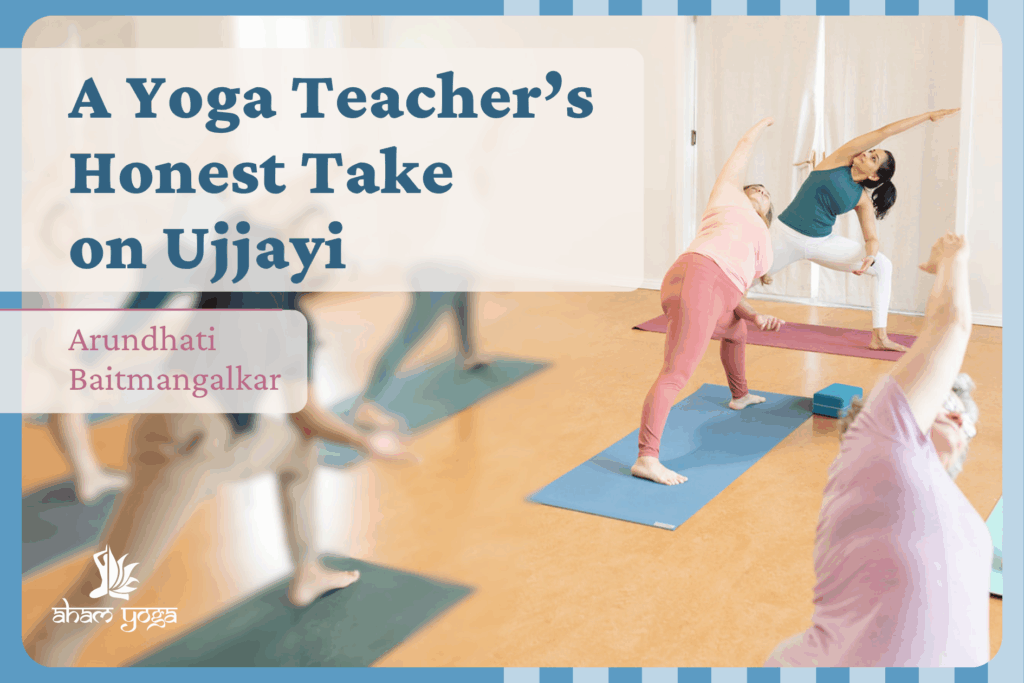
In standing poses that require spinal stability like Virabhadrasana, Trikonasana, Parsvottanasana – the increased intra-abdominal pressure from Ujjayi supports the spine from within. It is particularly useful in transitions between standing poses where the spine is most vulnerable.
As a concentration anchor – when the mind wanders or the practice becomes physically challenging, Ujjayi gives the mind something tangible to return to. The sound is self-generated and therefore always available.
Where Ujjayi doesn’t serve you:
In seated poses, the body is supported and spinal bracing is less necessary. The belly and back chest are the primary breathing territory here and Ujjayi’s constriction can actually interfere with the full, three-dimensional breath that deep forward folds and seated twists require.
In supine poses, the same logic applies. Savasana with Ujjayi is —and I say this gently a contradiction in terms. Savasana is the practice of complete release, of surrendering all control. Ujjayi is a controlled breath. The two work at cross purposes. There are other things we will explore in my pranayama teacher training about Ujjayi in asana too.
In restorative practice, the nervous system needs to fully downregulate. Ujjayi’s engagement, however subtle, keeps a layer of control active. The natural breath – soft, unmanipulated, free serves the restorative student far better.
Ujjayi in the World of Pranayama — A Nuance Worth Understanding
Here is something that surprises most vinyasa practitioners when they first encounter it.
In the classical pranayama tradition, Ujjayi is classified as a tranquilizing or cooling pranayama.
Read that again.
The breath you’ve been using to power through heating, dynamic vinyasa sequences? Classically, it’s a cooling breath.
This seeming paradox actually makes sense when you understand the mechanism. The glottal constriction slows the breath, activates the parasympathetic nervous system, and reduces the overall agitation of the mind. These are cooling, tranquilizing effects regardless of what the body is doing physically.
But here is the nuance: context changes everything in pranayama. Ujjayi in a dynamic, heating vinyasa practice will feel heating because the physical practice is heating. The breath is moderating the intensity making something that could be overwhelming, manageable. In a seated pranayama practice, Ujjayi’s cooling, tranquilizing qualities become fully available.
This is why pranayama is a lifetime study. The same technique produces different effects depending on the practitioner, the context, the season, and the stage of practice.
I explore the depths of this along with every major pranayama technique in the classical tradition — in my Pranayama Teacher Training and Study Program. If this conversation has opened something in you, I’d invite you to explore it further there.
A World Beyond Ujjayi — An Invitation
If you have been practicing yoga for any length of time and Ujjayi is the only breathing technique you know — this is not a criticism. It is an invitation.
There is a world of breath waiting for you.
And before any of the pranayama techniques, before you add a single new practice – there is the practice of simply learning to read your own breath. To notice where it moves and where it doesn’t. To feel the difference between a breath that reaches the side body and a breath that stays shallow in the chest. To understand what your breath is telling you about your nervous system, your energy, your readiness to go deeper.
That is breath literacy. And it changes everything.
I have explored many of these themes on my podcast Let’s Talk Yoga — one of the top 5% of podcasts globally, with over a million downloads across more than 200 countries. If you want to go deeper into the world of pranayama before committing to a full training, the podcast is a wonderful place to begin. There are so many pranayama related episodes – I have lost count. You can find the podcast here.
What I Would Tell Every Yoga Teacher
Use Ujjayi. It’s a beautiful, powerful, genuinely useful technique. But use it with intelligence – knowing what it does, when it serves, and when something else would serve better.
Know that your students’ breath is already intelligent before you give it a technique to follow. Teach them to listen to it, to read it, to trust it before you teach them to shape it.
Know that every time your student breathes whether they’re in Ujjayi or not they are touching prana. They are in contact with the same force that the yogis spent lifetimes learning to understand and work with. That is not a small thing. That deserves more than a single technique.
And if you are ready to go beyond Ujjayi if you feel the edges of your breath knowledge and want to move past them I would love to teach you.
My Pranayama Teacher Training and Study Program opens June 19th 2026. It is a 90% self-paced program rooted in the Indian tradition of pranayama not breathwork, not wellness breathing, but the real thing. Classical, rigorous, and deeply practical for modern teachers and serious students.
You can learn more and enroll at ahamyoga.com/pranayam-teacher-training.
Your breath has been waiting for this conversation. I hope this is the beginning of it.
Arundhati Baitmangalkar is a yoga educator, studio owner, and teacher trainer with over 20 years of experience. She is the founder of Aham Yoga in Redmond, Washington, and the host of Let’s Talk Yoga — a top 5% global podcast with over one million downloads. She has been published in Yoga Journal and Yoga International and has trained teachers across the United States and internationally.
Tags for SEO: ujjayi breath, ujjayi pranayama, yoga breathing techniques, pranayama for yoga teachers, breath literacy, yoga teacher training, pranayama teacher training, Aham Yoga, Let’s Talk Yoga, yoga breathing beyond ujjayi, classical pranayama, hatha yoga breathing
