

Most of us who celebrate Guru Purnima do it with a post. A photograph of our teacher, a folded hands emoji, a caption about gratitude. And almost none of us could tell you, if pressed, why this day exists. What it is actually marking. Why the tradition lives on which does nothing arbitrarily and chose this specific full moon, out of all the full moons in the year, to stop and bow.
That gap between the gesture and the understanding is exactly what this article is about.
Because Guru Purnima is not a yoga holiday in the way we have come to use that phrase. It is not an occasion for content. It is one of the most philosophically dense observances in the entire tradition, and if you teach yoga, if you practice yoga, if you have ever been changed by someone who knew something you didn’t – this day is asking something real of you. Let’s build that understanding.
The Astronomy Is Not Accidental
Guru Purnima falls on the full moon of Ashadha, the fourth month of the Hindu calendar. The timing is not sentimental. The tradition does not pick dates because they feel meaningful. It picks them because they are meaningful, because the external world and the internal world are understood to be in conversation, and the full moon is a precise moment in that conversation.
The full moon is the moment of maximum reflected light. The moon at its most luminous – not generating light of its own, but receiving it completely and giving it back completely. That image is the entire philosophy of the guru-shishya relationship compressed into a single night sky. The guru is the sun. The shishya is the moon. The practice is the learning to receive fully, and eventually to reflect what you have received without distortion.
The date was chosen because the date teaches the lesson.
Vyasa Purnima – The Name Most People Don’t Know
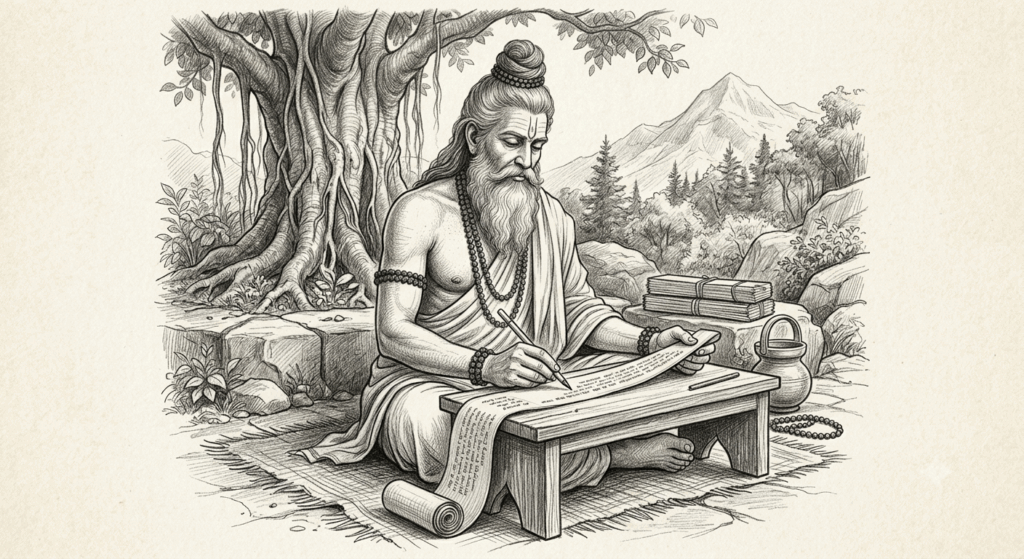
Guru Purnima is also called Vyasa Purnima, and that name carries the whole story of why this day exists.
Veda Vyasa is not a peripheral figure in this tradition. He is the person who looked at the vast body of knowledge living in oral transmission across India, understood that human memory and human lifespan were both shortening, and made the decision that would determine whether any of this survived: he wrote it down. He compiled and organized the four Vedas. He composed the Mahabharata, the longest epic in human literary history, inside which lives the Bhagavad Gita. He wrote the Bhagavata Purana. He is, in the most literal and consequential sense, the reason you have anything to read, practice, or teach today.
Guru Purnima honors him first. Not because he was the most enlightened being who ever lived, but because he understood that enlightenment means nothing if it cannot be transmitted. He was the great systematizer, the one who took living knowledge and gave it a form that could travel across time. Every teacher who has ever handed something real to a student is working in his lineage.
What the Word Guru Actually Means
The word has been so thoroughly absorbed into modern usage : as a synonym for expert, influencer, someone with a large following and or simply one who is an expert – that it has nearly lost its actual meaning. Let’s recover it.
Gu means darkness. Ru means that which dispels it. The guru is not the one who knows more than you. The guru is the force that moves you from not-knowing toward knowing, from confusion toward clarity, from the version of yourself that is lost to the version that can see.
That force is sometimes a person. Sometimes it is a text. Sometimes it is uncovering something, a loss, a challenging relationship, a test in the wrong company that you thought was right, a moral dilemma, a moment of complete undoing that reorganizes everything that follows. The tradition is clear that the guru principle is larger than any individual teacher. What we honor on Guru Purnima is not a personality. It is the force of transmission itself – the movement of light from one who holds it to one who is ready to receive it.
This is why the guru-shishya relationship is held so carefully in the tradition. Not because teachers are infallible – they are not, and we know this but because the transmission of living knowledge is understood to be one of the most sacred acts one human being can perform for another.
Why We Chose This Day
It is said that on this Purnima, in a place called Kantheshwar near the Himalayas, Adiyogi – Shiva, the first yogi turned toward the Saptarishis, the seven sages who had been sitting in his presence for months, and began to transmit the knowledge of yoga. They had waited. They had prepared. They had made themselves ready. And on this full moon, transmission began.
This is considered the moment yoga entered the human world. The first teaching. The birthday of the guru-shishya relationship itself.
Whether you hold this as literal history or as the kind of mythological truth that carries more meaning than fact, the point is the same. This day marks the moment that knowledge chose to move. That someone who held light decided to pass it. That someone ready to receive made themselves available. Guru Purnima is the annual remembrance of that first act of transmission and the endless chain of transmission it set in motion – a chain that reaches, through your teachers and their teachers before them, all the way to you.
The Guru-Shishya Parampara : Why This Relationship Is the Reason Yoga Exists
Knowledge in the Indian tradition was never meant to live in books alone. Texts are a vessel, a container, a way of keeping something safe across time. But the living substance of knowledge – the understanding that changes how you see, not just what you know — was always understood to require a living relationship for its full transmission.
The shishya is not a student in the academic sense. A student acquires information. A shishya makes themselves available to be transformed. The difference is the whole difference. Information can be downloaded. Transformation requires presence, trust, time, and a willingness to be undone by what you are learning.
The guru does not give the shishya information. The guru gives the shishya orientation – a way of seeing that, once genuinely received, changes the quality of everything that follows. You cannot un-receive it. You cannot go back to seeing the way you saw before. That is what real transmission does.
This is why the guru-shishya parampara – the lineage of teacher to student, generation to generation – is the actual infrastructure of yoga’s survival. Not the texts, though the texts matter. Not the poses, though embodied practice matters. The relationship. The willingness of one person who has walked further to turn back and reach for someone who is still finding the path.
Guru Purnima is the day this relationship is formally, consciously honored. Not because the guru needs the honor. Because the shishya needs the practice of giving it. Gratitude that is never expressed does something to the person who withholds it. This day is the correction.
For the Yoga Teacher – The Part That Asks Something of You
You are not the origin of what you teach. Sit with that for a moment before you move past it.
Everything you bring to the front of a room – the understanding, the language, the sequencing, the capacity to see what a student needs – was given to you. Someone transmitted it, imperfectly, generously, across the particular gap between their understanding and yours. And they received it from someone before them. And that person from someone before them. The line goes back further than you can trace.
Guru Purnima is the day to trace it honestly. To name your teachers – not only the comfortable ones, not only the ones whose methods you still endorse, but all of them. The ones who broke something open that needed breaking. The ones who showed you, by negative example, exactly what you did not want to become. The ones who saw something in you before you could see it in yourself. The ones who lit the light within you that you carry even today.
It is also the day to ask the harder question: is what was given to you being passed forward with the same integrity it was passed to you? Is your teaching transmission or performance? Are your students becoming more themselves through your teaching, or more like you? These are not comfortable questions. They are the right ones. Guru Purnima is the one day a year when the tradition formally asks you to sit with them.
For the Student – What Gratitude Actually Is
In the yogic tradition, gratitude is not a feeling. It is a practice. It is the active, conscious acknowledgment that what you have was given – that you did not arrive at understanding alone, that you did not pull clarity out of yourself by sheer individual effort, that someone sat with you and corrected you and held the knowledge steady while you slowly found your way toward it.
This acknowledgment is not humility as self-diminishment. It is accuracy. It is the honest recognition of how knowledge actually moves – not through isolated individual genius, but through relationship, through transmission, through the willingness of one person to give and another to receive.
Guru Purnima asks you to stop and know this. Not just feel it in a warm general way, but know it specifically. To be able to name what you did not know before you were taught. To be able to name the person or the practice or the moment that changed something real in how you see. That specificity is what transforms gratitude from sentiment into practice.
How to Observe It — Beyond the Post
Sit with your teacher if you can, in person or in practice. If your teacher is no longer living, sit with their teachings. Read something from the lineage that produced your practice, not for information but for contact with the mind that produced it.
Offer something that costs you something. Time, genuine reflection, a letter you actually write and send. Dana – giving – in the tradition is not transaction. It is acknowledgment that what you received has a value you cannot fully repay and are not expected to, but which deserves to be met with something real.
Write down the names of everyone who has taught you something that mattered. Go further back than you usually do. Include the teachers who didn’t know they were teaching you. Include the difficult ones. The ones who asked you to get uncomfortable.
And sit in meditation long enough to ask honestly: what did I not know before I was taught? What can I see now that I could not see then? That question, sat with seriously, is its own form of practice.
Where This Ultimately Lands
Every great teacher in this tradition has said some version of the same thing: I am pointing. I am not what I am pointing at. The guru-shishya relationship exists not to create permanent dependence but to make itself eventually unnecessary. Liberation – moksha – is not devotion to a teacher. It is the full internalization of what the teacher pointed toward, until the pointing is no longer needed because the seeing has become your own.
Guru Purnima is therefore not only a day of outward gratitude. It is an invitation to ask how clearly you can now see on your own. How much of what you were shown has become how you actually see, how you actually move through the world, how you actually meet other people. That is the measure of real transmission. Not what you can repeat, but what you have become.
Yoga did not survive because it was written in books. It survived because people chose to pass it forward — carefully, across thousands of years, at considerable personal cost, in the faith that whoever received it would carry it with the same care. Guru Purnima is the day we stop and know that. The day we remember that what we practice is not ours. We are holding it for the next person.
The question this day asks, every year on this full moon, is whether we are holding it well.
