
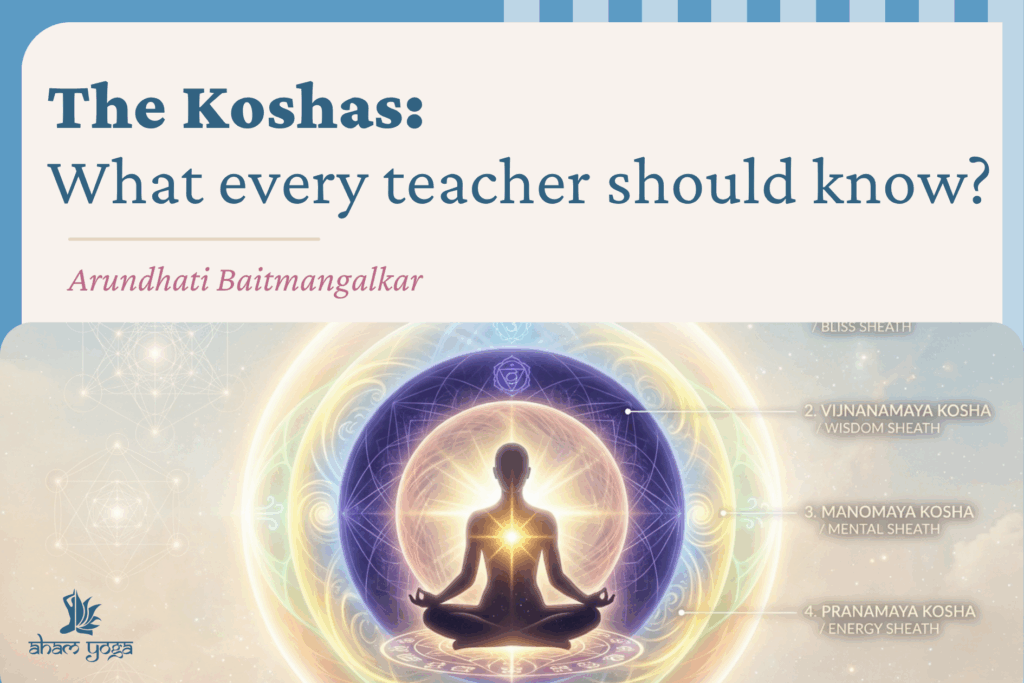
Most new teachers encounter the word kosha somewhere in their training – written on a whiteboard, mentioned in a lecture, maybe included in a handout they’ll find six months later at the bottom of a folder. They learn the five names, they move on, and the framework quietly gets filed under “philosophy I’ll come back to.”
The teachers who don’t do that – who actually sit with this model, who let it change how they see what’s happening in a room – teach differently. Not louder about it. Just differently.
Here’s what the koshas actually are, where they come from, and why they matter more to your teaching than almost anything else you learned in your training.
Where The Koshas Comes From
The kosha model doesn’t originate in a modern yoga manual or a teacher training curriculum. It comes from the Taittiriya Upanishad, one of the principal Upanishads and among the oldest of the śruti texts — revealed knowledge, not commentary, not interpretation. This is source material.
The teaching appears as a dialogue between the sage Varuna and his son Bhrigu. The instruction Varuna gives is simple and radical: know Brahman through inquiry. He doesn’t hand his son a map. He tells him to investigate – to look at what he takes himself to be, and keep looking until he finds what’s actually there. The pañchamaya model, the five-kosha framework, is the structure that emerges from that inquiry. It was never designed as a teaching tool for asana class. It was a map for self-realization. That origin matters, because it tells you what the framework is actually pointing at.
The Word Itself
Kosha (कोश) means sheath. Vessel. It’s the same word used for the scabbard of a sword — the casing that holds the blade. The Atman, the true Self, sits at the center, unchanging. The koshas are what surround it and, in the language of the tradition, obscure it — not what constitute it.
This is a distinction most trainings gloss over and it’s the one that changes everything. The koshas are not what you are. They are what you’ve been mistaking yourself for. The entire point of working with this framework is to see through that mistake, not to accumulate more refined versions of the sheaths.
The Five Sheaths
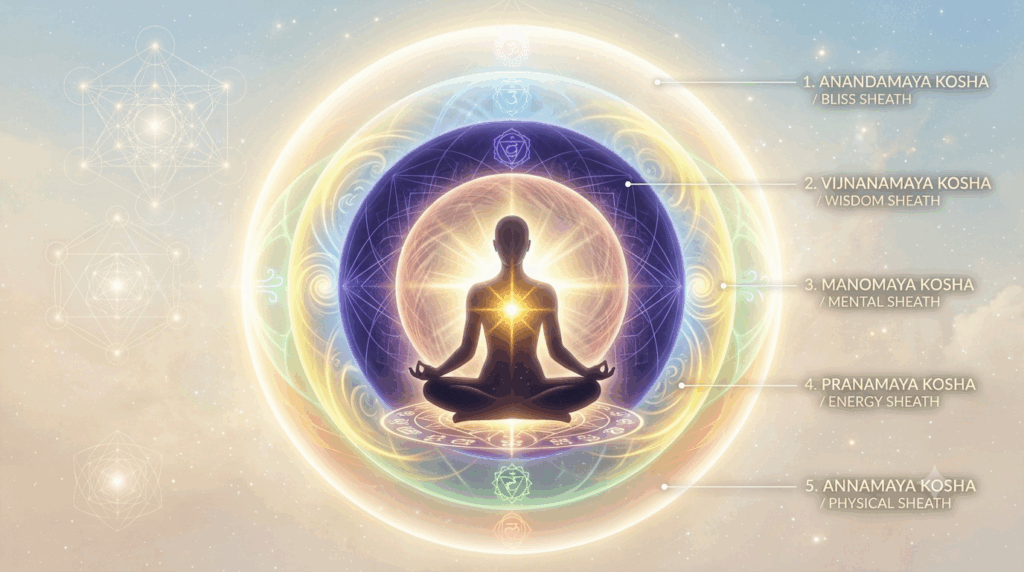
Annamaya Kosha — sustained by food. Anna means food, not simply “matter” or “the physical.” This is the gross body, the one you can touch, measure, and put into a posture. It is the most visible sheath and, for most students who walk through a studio door, the only one they know they have.
Pranamaya Kosha — sustained by prana, the vital breath-energy that animates the physical. This sheath interpenetrates the annamaya entirely. You cannot separate them in practice, only in description. Pranamaya is why two students can do the same pose with the same alignment and have completely different experiences — the breath, and the energy it carries, is not the same in both bodies.
Manomaya Kosha — sustained by sense impressions and thought. This is the processing mind — the part that receives input from the senses, forms reactions, carries emotional patterns and memories. It is not the thinking mind in the intellectual sense. It is closer to the part of you that responds before you’ve decided to respond.
Vijnanamaya Kosha — sustained by discernment. Buddhi. The witness behind the thoughts. This is the part of you that knows the difference between a reaction and a response, that can observe the manomaya rather than be swept along by it. Most people access this sheath intermittently, in moments of unusual clarity, or after years of practice.
Anandamaya Kosha — sustained by deep rest and proximity to the Self. The word ananda is usually translated as bliss, which leads most students to picture a feeling — something warm and luminous that arrives occasionally in savasana. The tradition means something closer to the ground state of being before the noise starts. This is the subtlest sheath, the one nearest to the Atman, and the one most easily missed because it cannot be reached by effort.
The Koshas Are Not a Stack
Western yoga teaching frequently presents the koshas as layers you work through in sequence – start at the physical, move inward toward the blissful. This is a useful teaching simplification and also a significant distortion of what the tradition actually says.
Adi Shankaracharya’s commentary on the Taittiriya Upanishad is unambiguous: each kosha is said to be the sharira, the body, of the one within it. They interpenetrate completely. They are simultaneous. You are never operating in only one kosha. The physical and the energetic and the emotional are not separate events happening in sequence — they are one event being perceived through different dimensions of your experience at once.
The practical consequence of this is important: you cannot do purely physical yoga. There is no such thing. Every time you put a body into a pose, you are touching all five sheaths whether you intend to or not. The only question is whether you’re teaching with that awareness or without it.
What This Means When You’re Standing at the Front of a Yoga Class
The breath is not an add-on. Pranamaya kosha is the bridge between the physical body and the mind. Without conscious, intentional breath in your teaching, the practice stays at the surface. A class where breath is an afterthought is a class that stops at annamaya. Most students feel the difference, even if they can’t name it.
Emotional releases in class have a structure. When a student cries in a hip opener, or feels inexplicably anxious in a backbend, or goes somewhere else entirely during a long hold – that is manomaya. Sense impressions, emotional patterns, and stored experience live in this sheath, and asana moves them. This is not mystical. It is the direct consequence of working with a body that is not separate from a mind. Knowing this makes you a steadier, more intelligent teacher in those moments.
The same student will do the same pose differently every week. This is vijnanamaya at work, or not at work. When a student is discerning, present, and connected, their practice reflects it. When they’re reactive, distracted, or in their head, you’ll see that too. A good teacher reads this and adjusts — not the pose necessarily, but the tone, the pace, the language of the room.
Savasana is not optional. Anandamaya cannot be rushed. It requires stillness and the complete withdrawal of effort. When you cut savasana short, or let students pack up early, you’re not just skipping the rest at the end — you’re closing the door on the subtlest and most integrative part of the practice. The tradition knew this. It’s why every classical sequence ends in stillness, and why that stillness was never treated as optional.
These are very basic examples to help you understand the koshas. But know that their significance runs far deeper and greater than in just an asana class or yoga pose.
Living The Koshas, Not Just Teaching Them
The koshas are not only a teaching framework. They are a personal lens, and the teachers who use them that way are the ones who grow differently than their peers.
When you’re reactive in a situation – frustrated, depleted, stuck – the question “which kosha is driving this?” is not a philosophical exercise. It is a genuinely useful diagnostic. Is this physical exhaustion? Disrupted prana from shallow breathing and poor sleep? A manomaya pattern that’s been triggered? Vijnanamaya offline because you haven’t had ten minutes of stillness in three days?
A physical injury rarely lives only in annamaya. The breath patterns around it, the movement compensations, the emotional relationship to the pain – pranamaya and manomaya are always involved. A teacher who understands this approaches their own healing differently. And they approach their students’ injuries differently too.
The consistency of a personal practice also makes more sense through this lens. You’re not doing it to stay flexible or to maintain a pose. You are doing it to keep all five sheaths in relationship with each other, which is what it means to be integrated, which is what the word yoga actually points at.
Teaching From The Kosha Map
The teachers who understand the koshas don’t necessarily talk about them more in class. In fact, the best ones rarely name them at all. What changes is everything underneath the language — the sequencing, the breath cuing, the timing of stillness, the way they read a room. They are teaching the whole person because they know the whole person is present.
That’s the shift. Not that you add philosophy to your classes, but that your classes stop being about shapes and start being about what the tradition always said they were about — the inquiry into what a human being actually is.
The koshas were never a curriculum item to check off. They were a map passed from teacher to student across centuries, pointing at the same thing they’ve always pointed at: the Self that was never the sheath.
When you teach from that understanding, your students feel it. Even the ones who’ve never heard the word. You can teach the koshas deeply without ever labeling them.
Let me know if you would like me to do a deeper dive on these on the Let’s Talk Yoga podcast sometime.
