
I want to ask you something.
If I put you in a room with fifty yoga teachers and asked them — what asana best prepares the body for pranayama — how many of them do you think would say chest opening?
Most of them. Maybe all of them.
I know, because I have asked this question inside my Pranayama Teacher Training for six years running. And the answer is almost always the same: chest opening. Heart opening. Front body opening. Sometimes delivered with such confidence that no one in the room questions it.
I used to leave a pause before I responded. Not for drama though I’ll admit it has a bit of that but because what I’m about to say runs so counter to what most of us were taught that it needs a moment to land.
Chest opening is last on my list.
Not first. Not second. Not even third. Last.
And by the time you finish reading this post, I hope you’ll understand exactly why — and walk away with a genuinely different way of thinking about how to prepare the body for pranayama. Whether you’re a practitioner building your own practice or a teacher trying to help your students go deeper, this is information that will change how you work.
First: The Mistake Almost Everyone Makes Before They Even Begin
Here is the most common pranayama mistake I see — and it happens before a single technique is introduced.
People skip the body.
They go straight to the breath. They learn Nadi Shodhana, they learn Kapalabhati, they sit down and try to practice and then they wonder why the pranayama feels effortful, stuck, shallow, or just plain uncomfortable. Why the breath won’t go where they want it to go. Why they can’t sustain a practice for more than a few minutes without something tightening, gripping, or pulling.
The answer is almost always in the body. Not the breath.
This is one of the foundational teachings in my Pranayama Teacher Training, and it is rooted in something the classical texts understood clearly: the body is the container of prana. You cannot refine what flows through a container without first preparing the container itself.
In practical terms this means that asana done intelligently with pranayama in mind — is not just a warm-up or a separate practice. It is the physical architecture that either supports or limits everything you are trying to do with your breath. And when that architecture is wrong, no amount of technique will fix it.
So. What does the right architecture look like?
The Five Categories of Asana That Actually Prepare You for Pranayama
These are in order of priority. Read that twice — the order matters.
1. Side Body Opening
This is where I want every pranayama student to start, and it is almost universally underemphasised in how we sequence classes.
Here is the anatomical reality: seventy percent of your lung tissue is posterior and lateral. Seventy percent. That means the majority of your breath capacity lives in your back body and your side body — not in the front of your chest. When we open the lateral ribcage, when we lengthen the intercostal muscles between the ribs, when we create space in the obliques and the side waist, we are directly expanding the territory that breathing actually occupies.
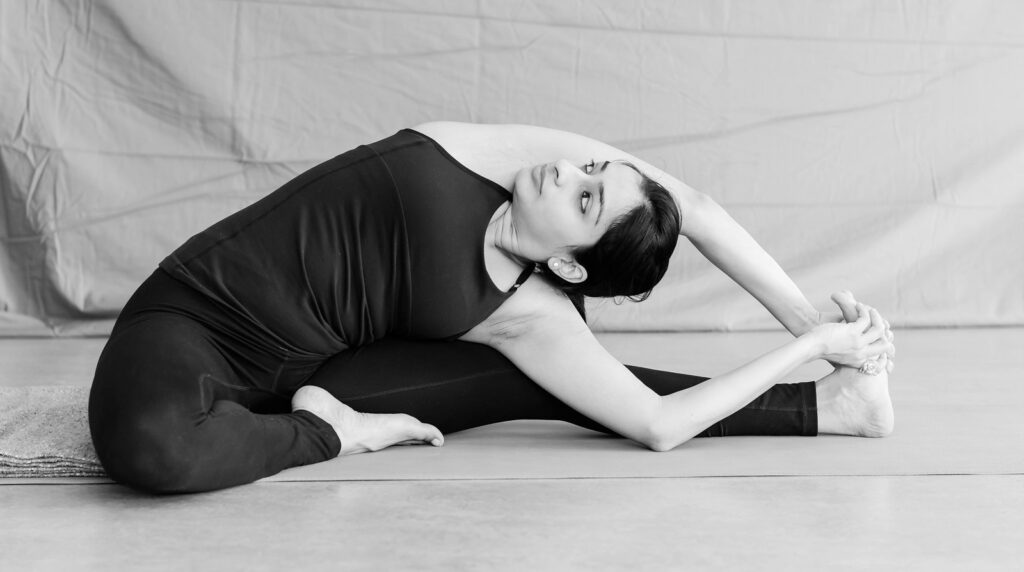
Think about what happens in a deep side stretch — a proper Parsvakonasana or a Parighasana or even a simple seated lateral stretch held for several breaths. If you pay attention, you will feel the ribs on the upper side begin to separate on each inhale. That separation is not incidental. It is the body creating room for the breath to expand laterally — which is exactly where most of us have almost no breath capacity at all.
Poses to explore for side body opening: Parsvakonasana (extended side angle), Trikonasana (triangle), Parighasana (gate pose), seated lateral stretches, supine banana pose, supported side stretches over a bolster and more that we will cover in the live training.
2. Back Body Lengthening
After side body, come to the back.
This is the area where the largest portion of lung tissue lives, and it is also the area most compressed by modern sedentary life. Hours at a desk, driving, looking at screens — these activities pull the thoracic spine into flexion and compress the posterior ribcage in ways that directly limit the breath’s ability to expand backward.
When the back body is compressed, diaphragmatic breathing is compromised. The diaphragm needs posterior expansion as much as anterior. If the back ribs cannot move, the diaphragm cannot descend fully, and you are left with a breath that stays in the upper chest no matter how hard you try to deepen it.
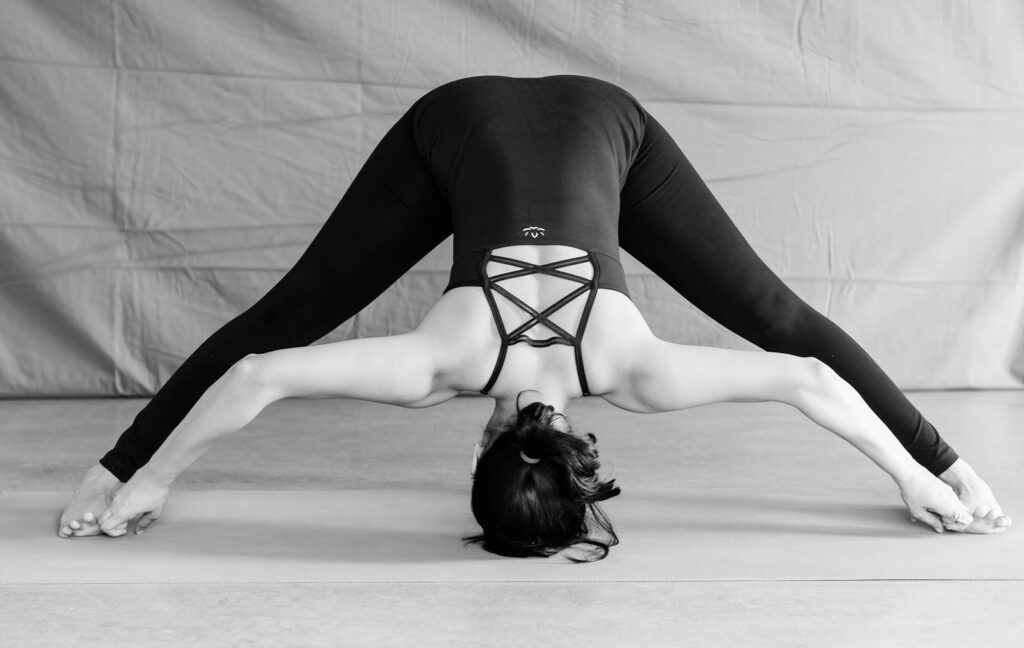
Back body lengthening does not mean forward folds alone though poses like Paschimottanasana and Uttanasana, held gently and with a soft belly, do create length in the posterior chain. It also means poses that decompress the thoracic spine: supported fish, gentle inversions, and any asana that allows the back ribs to breathe.
The test is simple: in your next forward fold, take a full breath and notice whether you can feel the back ribs expanding. If you cannot — if the breath stays flat and the back is rigid — you have found the first thing to work on in your pranayama preparation.
Poses to explore for back body lengthening: Paschimottanasana, Uttanasana, Balasana (child’s pose), supported fish, and Adhomukha Swanasana side stretch amongst others.
3. Hip Flexors, Quads, and Lower Abdomen
This one surprises people most. What do the hips have to do with breathing?
Everything, as it turns out.
The diaphragm does not work in isolation. It is part of a pressure system that runs from the pelvic floor all the way up through the respiratory diaphragm. When the psoas which attaches to the lumbar vertebrae and the inner femur is chronically tight, it pulls the lumbar spine forward into extension, tilts the pelvis anteriorly, and creates a gripping pattern in the lower abdomen and hip flexors.
In that state, the diaphragm cannot descend fully on the inhale. The breath has nowhere to drop. It gets stuck in the upper chest because the lower container is rigid and locked.
This is extraordinarily common. Most modern humans especially those who sit for long periods have some degree of psoas tension. And no amount of chest opening will release it. You have to address the container from the bottom up.
When the hip flexors lengthen, when the quads release, when the lower abdomen softens — suddenly the diaphragm has room to move. The breath drops. The belly expands. The whole respiratory system functions the way it was designed to.
This is why Anjaneya is one of my favourite poses to do before a seated pranayama practice. It addresses the hip flexors, opens the lower abdomen, and gently decompresses the lumbar spine — all in one long, supported hold. The pranayama that follows is noticeably different.
Poses to explore for hip flexors and lower abdomen: Low lunge (Anjaneyasana), Supta Virasana, Virasana, Ustrasana approached carefully, Setu Bandha, amongst others.
4. Spinal Rotation
Twists are pranayama preparation. Most teachers do not frame them this way, but they should.
Here is why. The thoracic spine — the mid and upper back — is where rotation naturally lives. When the thoracic spine rotates fully and freely, the ribcage moves with it. This movement is one of the primary mechanisms by which the breath expands three-dimensionally. A thoracic spine that cannot rotate is a ribcage that cannot breathe fully — not in all directions.
Twists also have a direct effect on the internal organs. As the torso rotates, the abdominal organs are gently compressed and then released. This compression-and-release pattern improves circulation to the organs and tones the abdominal muscles that support the breath. Samana vayu — the pranic force associated with digestion, balance, and the mid-region of the body — is directly supported by spinal rotation.
There is also a nervous system dimension here. Well-executed twists — held with breath, without gripping — are deeply regulating. They help the nervous system settle before pranayama practice in a way that forward folds and backbends alone often cannot.
Poses to explore for spinal rotation: Bharadvajasana, Marichyasana, Ardha Matsyendrasana, supine twists (Supta Matsyendrasana), Parsva Uttanasana, Parivrtta Trikonasana.
5. Chest Opening — Yes, Last
And now we arrive at the one everyone starts with.
Chest opening is genuinely valuable. I want to be clear about that. Backbends and front body openers expand the anterior ribcage, lift the sternum, stretch the pectorals and the intercostals, and can create a sense of spaciousness that feels directly connected to the breath.
But here is the thing. When the side body is already open, the back body is already long, the hip flexors are already released, and the spine is already rotating freely — the chest opens as a natural consequence. It does not need to be forced. It arrives as the fruit of all the preparation that came before it.
Cueing chest opening as the primary or first category of pranayama preparation is like trying to open a flower by pulling the petals apart. The flower opens when the conditions are right. Force it open before the conditions exist, and you get something that looks like openness but lacks the function of it.
The shape without the breath. Which, when you are preparing for pranayama, is exactly backwards.
Poses to explore for chest opening — as the final layer of preparation: Setu Bandha, supported fish, gentle Ustrasana, Bhujangasana, Anahatasana (puppy pose).
What This Looks Like in Practice
Let me make this concrete.
The next time you are preparing for a pranayama session — or sequencing a class that ends in pranayama — run through this checklist before you sit down:
Have I opened the side body? Even two minutes of lateral stretching on each side changes what is available in the breath.
Have I lengthened the back body? A gentle forward fold, a child’s pose, anything that creates space in the posterior ribcage.
Have I addressed the hip flexors and lower abdomen? Even a simple low lunge on each side, held for five to eight breaths, releases enough tension to change the quality of the breath.
Have I given the spine some rotation? One twist on each side. That is all it takes to unlock the thoracic spine and free the ribcage.
If you can answer yes to all four — sit down, close your eyes, and notice what happens. The breath will be different. Fuller. More dimensional. Less effortful. The chest will have opened on its own, as a consequence of everything else being prepared.
That is the pranayama practice working. That is breath literacy.
Why This Matters More Than You Think
I teach this framework inside my Pranayama Teacher Training — and the response is always the same. Students sit in silence for a moment and then someone says: I have been doing this backwards my whole teaching career.
Not because they were careless teachers. But because no one gave them this information. Because pranayama, in most 200-hour teacher trainings, gets a module — maybe two days if you’re lucky — and in that module there is no time to go this deep. You learn a few techniques, you practice them, and you move on.
The result is thousands of dedicated yoga teachers who understand the poses but not the body’s relationship to breath. Who can teach Nadi Shodhana but cannot explain why a student’s practice feels stuck. Who default to “open your chest” because it is the answer they were given — and it sounds right, even though it is incomplete.
The breath deserves better than that. And so do your students.
If This Is Opening Something For You
This is exactly the kind of inquiry we go deep into in my Pranayama Teacher Training and Study Program — now in its sixth year, and rooted in the Indian tradition that gave us this practice.
We spend real time on asana preparation for pranayama. We cover the five pranic forces (pancha vāyus) and what they mean for how you sequence and teach. We go through every major pranayama technique in the classical tradition — not just the names, but the stages, the ratios, the contraindications, the energetic effects, and the pedagogy for bringing them to your students with genuine confidence.
It is a 60-hour training. It integrates into the 300-hour path. It runs once every 18 months.
→ Full details and enrollment: ahamyoga.com/pranayam-teacher-training
If you have questions, email us at [email protected]. I read everything.
Happy practising,
Arundhati
